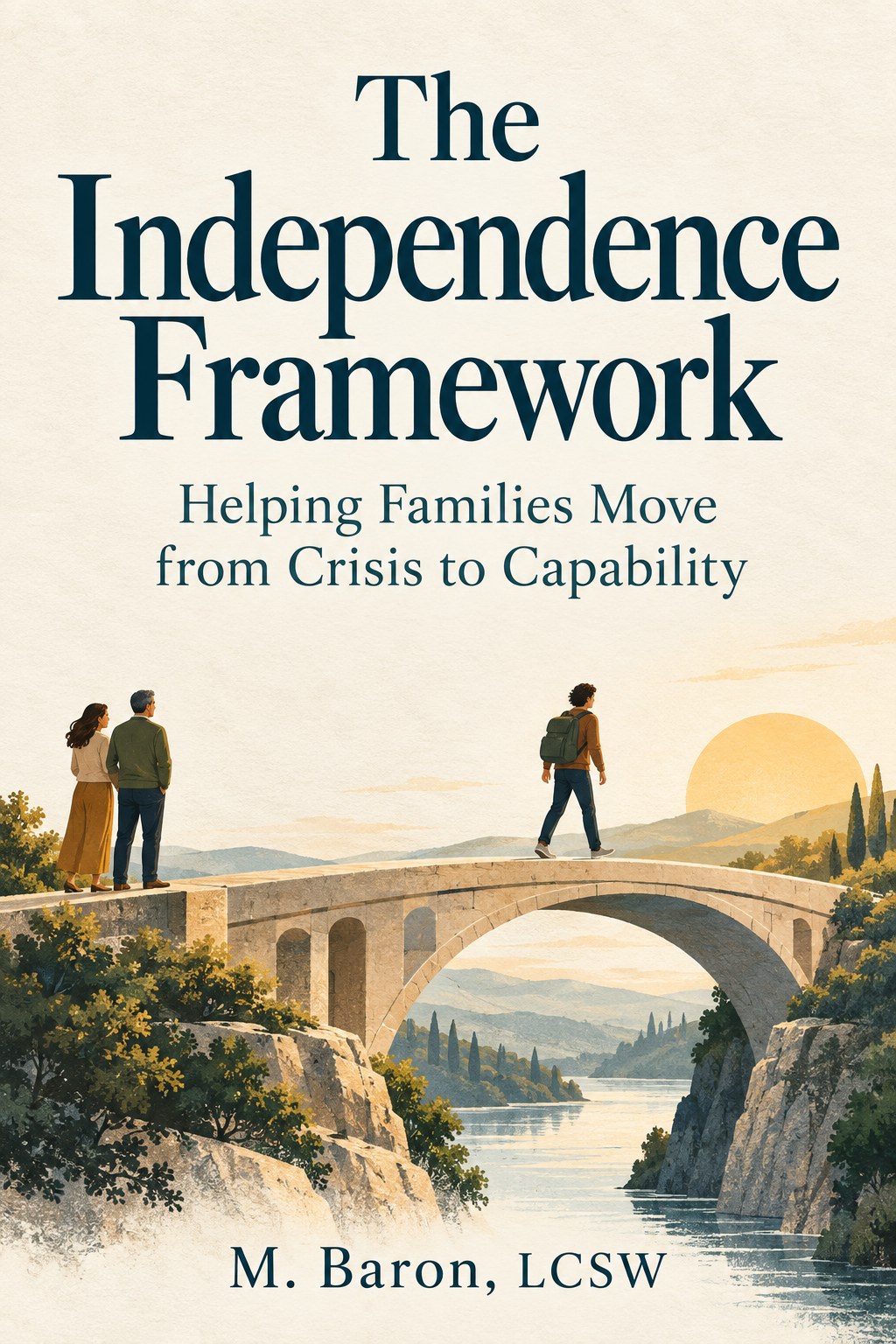
A book for parents · By M. Baron, LCSW
The Independence Framework
Helping Families Move from Crisis to Capability
How families drift into crisis one decision at a time — and how calm leadership, clear structure, and well-calibrated support lead them back out. Written for parents of kids, teens, and young adults who are still in the fight.
Explore the live classes About the bookThe book
The Independence Framework: Helping Families Move from Crisis to Capability, by M. Baron, LCSW, distills a therapist's approach into a guide for parents: how families drift into crisis one decision at a time, and how calm leadership, clear structure, and well-calibrated support lead them back out.
It's written for the parents in the thick of it — the ones who have stayed in the fight through every frustrating moment — and for anyone who believes a diagnosis should explain what someone is experiencing, never define who they are or cap who they can become.
Inside the framework
Four ideas run through the book — each one a shift in how a family leads itself.
Lead, don't react
Families don't lose control all at once; they lose it one decision at a time. Leadership begins where reactivity ends — a calmer way to read what's happening at home, and an order of operations for a hard season: stabilize, structure, then grow.
“Leadership creates security. Control creates resistance. Confusing the two creates fear.”
Structure makes love visible
Children experience love not only through affection, but through consistency, safety, and predictability. Clear expectations — set early, calmly, and together — are how that structure takes shape.
“Structure is one of the ways love becomes visible.”
Support that builds capability
Good support makes a child more capable; rescue makes them more dependent. The work is calibrating support — what to hand over, what to keep holding, and how to raise expectations at a pace your child can actually meet.
“Independence is not the absence of support. It is the growing ability to carry responsibility with progressively less support.”
Raise them to leave
One of the strangest measures of successful parenting is that, over time, your child should need you less. The goal is not independence from influence — it is independence of judgment.
“Our job is to raise children to leave us.”
From the book
“Trust is not restored by reassurance. It is restored by repeated evidence.”
“Families don't rise to the occasion. They fall to the level of their systems.”
“A diagnosis should help explain what someone is experiencing. It should never become the definition of who they are or the ceiling on who they can become.”
Live classes for parents
Therapy works one family at a time. These classes bring the same approach to a small group of parents learning together — taught live online by M. Baron, LCSW, with practical teaching, real examples, and room for your questions as they come up.
Each class series meets live online in a small group. Sign up below for the next live class series — the schedule and registration details are announced to those who sign up first.
From Crisis to Capability
How families drift into crisis one decision at a time — and how to climb back out. You'll take away a calmer way to read what's happening at home, a clear order of operations for a hard season (stabilize, structure, then grow), and language for leading instead of reacting.
Building Independence at Home
Good support makes a child more capable; rescue makes them more dependent. You'll take away a practical way to calibrate support — what to hand over, what to keep holding, and how to raise expectations at a pace your child can actually meet.
Communication & Boundaries
Clear expectations, honest conversation, and boundaries that hold without becoming power struggles. You'll take away a real process for disagreement, follow-through that doesn't depend on the mood of the day, and a way to present a united front as parents.
Sign up for the next live class series
Classes are held live online, in small groups. Sign up here for the next live class series — the schedule and registration details are announced to those who sign up first. Tell us which class fits your family, and we'll be in touch.
This website offers education for parents — it is not therapy, and signing up does not create a therapeutic relationship. If you or someone you love is in crisis, call or text 988 (Suicide and Crisis Lifeline) or call 911.
About the author

M. Baron, LCSW is a licensed clinical social worker and the author of The Independence Framework. Through Emotion Lab Therapy, he works with kids, teens, young adults & parents — helping families move from crisis to capability.
His approach is built on a simple conviction: families don't become healthier because they find the perfect rule. They become healthier because they learn how to lead.
Follow along: @emotionlabtherapy on Instagram · emotionlabtherapy.com